The Lack of Automated Payout Orchestration: A Hidden Cost Burden to Gig Marketplaces
The Lack of Automated Payout Orchestration: A Hidden Cost Burden to Gig Marketplaces
Title Tag: The Hidden Cost of Manual Payouts: Why Gig Marketplaces Need Automated Payout Orchestration | MyGigsters
Meta Description: Manual payout systems cost gig marketplaces billions. Discover how automated payout orchestration reduces churn by 15%, cuts compliance costs, and drives marketplace growth.
The $1.27 Trillion Problem Hiding in Plain Sight
Picture this: You've built the next big gig marketplace. Orders are flowing, workers are delivering, and your platform fee is growing steadily. But behind the scenes, your finance team is drowning in Excel spreadsheets, manually reconciling thousands of payments, and dealing with angry gig workers whose paychecks are stuck in processing limbo—again.
This isn't just an operational headache. It's a profit-killing, growth-strangling crisis that's plaguing the entire gig economy.
With 70+ million Americans now freelancing and contributing $1.27 trillion to the US economy, the gig marketplace sector has reached unprecedented scale. Yet most platforms are still running their payout operations like it's 2010, using manual processes that were never designed for today's volume and complexity.
The result? Hidden costs that are bleeding marketplaces dry, one delayed payment at a time.
The Real Problem: Manual Payout Operations Don't Scale
When Spreadsheets Meet Millions of Transactions
The gig economy has exploded from a niche side-hustle phenomenon to a $646 billion global market. Gig-based businesses alone are projected to grow from $25.7 billion in 2024 to $138.9 billion by 2033—a staggering 20.4% compound annual growth rate.
But here's the disconnect: while marketplace transaction volumes have grown exponentially, most platforms are still managing payouts with the same manual, labor-intensive processes they started with.
Every week, finance teams across thousands of gig marketplaces are:
- Manually calculating earnings for each worker
- Cross-referencing payments against completed jobs
- Dealing with failed bank transfers and outdated payment information
- Hunting down missing tax forms and compliance documentation
- Fielding support tickets from frustrated workers asking ""Where's my money?""
This manual approach might work when you're processing hundreds of payments. It becomes a nightmare when you're handling thousands or millions.
The Compliance Trap That's Catching Everyone
The regulatory landscape has become a minefield. Financial institutions now spend $61 billion annually on compliance across the US and Canada, with 99% of organizations reporting increased compliance costs.
For gig marketplaces, the challenges are multiplying:
- 1099-K thresholds are plummeting: From $20,000 in 2023 to $5,000 in 2024, with plans to drop to just $600 by 2026
- 74% of gig workers are unaware of these changing tax reporting requirements
- State-by-state money transmitter licensing can cost platforms $500,000 to $1 million for nationwide operations
- KYC and AML requirements generate 90-95% false positive rates, costing billions in manual investigations
Without automated systems to handle these requirements, marketplaces are drowning in administrative overhead.
The Hidden Costs That Kill Marketplace Growth
1. Direct Financial Impact: The 15% Churn Crisis
Research shows that churn from delayed payouts can cost companies up to 15% of annual sales. For a marketplace generating $10 million annually, that's $1.5 million in lost revenue—every single year.
Payment delays don't just annoy workers; they drive them to competitors. In the gig economy, payment speed directly impacts satisfaction and retention. When multiple platforms offer similar opportunities, workers consistently choose the one that pays fastest.
2. Operational Expenses: Death by a Thousand Manual Tasks
The true cost of manual payout operations is often hidden across multiple budget lines:
- Finance team salaries: Teams spending 40+ hours weekly on manual reconciliation
- Customer support overhead: Payment-related tickets typically account for 30-50% of support volume
- Technology debt: Patching together multiple systems that don't communicate
- Audit and compliance costs: External auditors charging premium rates to untangle messy financial records
A mid-sized marketplace processing 10,000 payments monthly typically needs 2-3 full-time employees just for payout operations. At $80,000 average salary plus benefits, that's $200,000+ annually in direct labor costs—before accounting for the opportunity cost of what those employees could be doing instead.
3. The False Positive Tax: $3 Billion in Wasted Investigations
Anti-money laundering systems plagued by 90-95% false positive rates are costing the industry $3 billion annually in unnecessary investigations. Each false alert requires 30 minutes of manual review time, creating massive administrative burden for marketplaces trying to stay compliant.
Large institutions process millions of transactions daily. Even with 95% accuracy, that still means 950 false alerts per million transactions. For growing gig marketplaces, these compliance costs can quickly spiral out of control.
4. Data Breach Risk: The $4.88 Million Mistake
Manual processes create security vulnerabilities. The average data breach now costs $4.88 million, with payment sector breaches running even higher. When finance teams are juggling spreadsheets full of sensitive payment information, the risk of human error—or malicious access—increases dramatically.
Less than 50% of organizations maintain year-over-year PCI compliance, largely due to the operational complexity of manual payment processes.
Real-World Impact: How Manual Payouts Destroy Marketplace Momentum
Case Study: The Scaling Nightmare
Consider a food delivery marketplace that grew from 1,000 to 50,000 active drivers in 18 months. Their manual payout process, which worked fine at small scale, became a bottleneck:
- Payment delays increased from 1-2 days to 5-7 days as volumes grew
- Error rates spiked to 8% due to manual data entry mistakes
- Driver churn increased 40% as competitors offered daily payouts
- Finance team grew from 2 to 8 employees just to handle payments
- Customer support was overwhelmed with payment-related inquiries
The real killer? They discovered that 20% of their highest-earning drivers had switched to a competitor specifically because of payout delays. These weren't just any drivers—they were the platform's most valuable workers, handling premium orders and maintaining the highest customer ratings.
The Domino Effect of Payment Problems
When payout operations break down, the damage cascades:
- Worker dissatisfaction leads to negative reviews and social media complaints
- Service quality drops as the best workers leave for competitors
- Customer experience suffers due to reduced worker availability
- Marketplace reputation takes a hit, making it harder to attract new workers
- Growth stagnates as operational issues consume management attention
This isn't theoretical. We've seen it happen to dozens of marketplaces that waited too long to modernize their payment infrastructure.
The Compliance Time Bomb
The regulatory environment isn't getting easier. With Form 1099-K thresholds dropping to $600 by 2026, millions of additional payment records will need to be processed and reported. The IRS has also lowered e-filing requirements to just 10 forms, catching many smaller platforms off-guard.
Marketplaces using manual processes will face impossible choices:
- Hire armies of compliance staff to handle the paperwork
- Restrict platform access to avoid crossing reporting thresholds
- Accept massive regulatory penalties for non-compliance
None of these options support sustainable growth.
The Solution Framework: Automated Payout Orchestration
What Is Payout Orchestration?
Payout orchestration is the automated coordination of all payment-related processes—from earnings calculation to final disbursement, including compliance monitoring, fraud detection, and reconciliation.
Think of it as the nervous system for your marketplace's financial operations, automatically handling the complex web of tasks that currently require manual intervention.
The global payout orchestration market reached $4.28 billion in 2024 and is projected to grow at 20.3% CAGR through 2033, reaching over $13 billion. This rapid adoption reflects the critical need for automation in payment operations.
Key Components of Effective Payout Orchestration
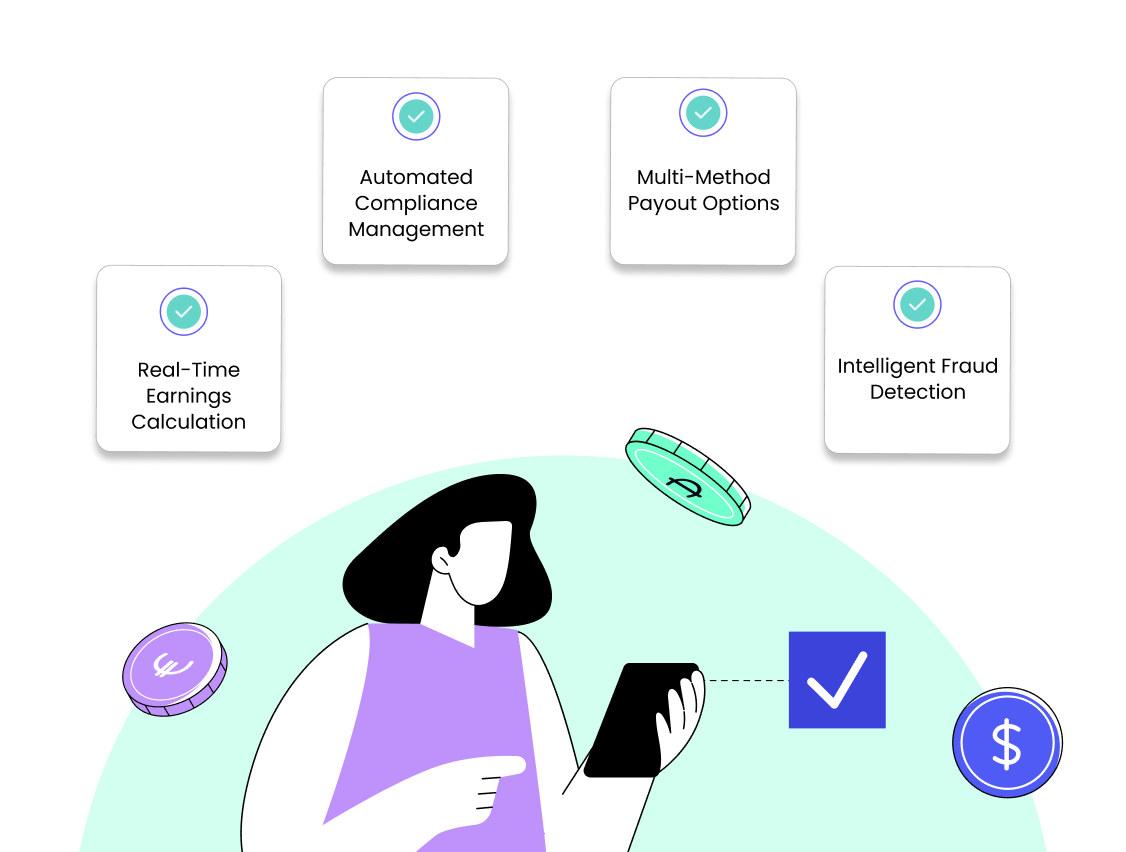
1. Real-Time Earnings Calculation
- Automatically track completed jobs and calculate earnings
- Apply commission structures and fee deductions
- Handle complex scenarios like tips, bonuses, and adjustments
- Provide instant earnings visibility to workers
2. Automated Compliance Management
- Generate required tax forms (1099-K, 1099-NEC) automatically
- Handle state-by-state reporting requirements
- Maintain audit trails for regulatory inquiries
- Monitor transaction patterns for AML compliance
3. Multi-Method Payout Options
- Bank transfers, digital wallets, prepaid cards
- Real-time and scheduled payment options
- International payout capabilities
- Automatic retry logic for failed payments
4. Intelligent Fraud Detection
- AI-powered transaction monitoring
- Behavioral analysis to catch unusual patterns
- Automated risk scoring and approval workflows
- Reduced false positive rates through machine learning
5. Comprehensive Reconciliation
- Automatic matching of payments to earnings
- Exception handling for discrepancies
- Real-time financial reporting
- Integration with accounting systems
The ROI of Automation
Organizations implementing automated payout orchestration typically see:
- 50-70% reduction in false positive investigations
- 75% decrease in manual reconciliation time
- 15-20% improvement in worker retention rates
- 40-60% reduction in payment-related support tickets
- 90%+ accuracy in compliance reporting
For a marketplace processing $50 million annually in worker payments, automation can generate $2-5 million in direct cost savings and retained revenue within the first year.
Building Your Payout Orchestration Strategy
Phase 1: Assessment and Planning (Months 1-2)
Audit Current Processes
- Map every step in your payment workflow
- Identify manual touchpoints and bottlenecks
- Calculate current operational costs
- Document compliance requirements
Define Success Metrics
- Payment processing time
- Error rates and exception handling
- Worker satisfaction scores
- Compliance audit results
- Operational cost per payment
Phase 2: Core Automation (Months 3-6)
Implement Automated Earnings Calculation
- Connect to your job completion systems
- Automate commission and fee calculations
- Build exception handling workflows
- Create real-time earnings dashboards
Deploy Multi-Method Payouts
- Integrate with payment processors
- Offer multiple payout options to workers
- Implement automatic retry logic
- Build status tracking and notifications
Phase 3: Advanced Features (Months 7-12)
Add Compliance Automation
- Integrate tax form generation
- Implement AML monitoring
- Build audit trail capabilities
- Create regulatory reporting dashboards
Deploy AI-Powered Fraud Detection
- Implement behavioral analysis
- Build risk scoring models
- Create automated approval workflows
- Optimize false positive rates
Phase 4: Optimization and Scaling (Ongoing)
Continuous Improvement
- Monitor system performance metrics
- Gather worker feedback and iterate
- Optimize processing speeds and accuracy
- Scale infrastructure as volumes grow
The MyGigsters Advantage: Experience-Driven Solutions
Having worked 19 different gigs himself, MyGigsters founder Benji Elengovan understands the payment pain points from both sides of the marketplace equation. This real-world experience, combined with deep fintech expertise, gives MyGigsters a unique perspective on what actually works in payout orchestration.
Our approach focuses on:
- Worker-centric design: Because happy workers drive marketplace success
- Compliance-first architecture: Built for today's regulatory environment
- Scalable infrastructure: Designed to grow with your platform
- Integration simplicity: Minimal disruption to existing operations
We've seen too many marketplaces struggle with payment issues that could have been prevented with proper planning and the right technology partners.
Take Action: Don't Wait for the Crisis
The gig economy's explosive growth isn't slowing down. 70 million Americans are already freelancing, and that number is growing every day. The marketplaces that will thrive in this environment are those that can efficiently, accurately, and quickly pay their workers while staying compliant with evolving regulations.
Manual payout processes might have gotten you to where you are today, but they won't take you where you need to go tomorrow. Every day you delay implementing automated payout orchestration is another day you're:
- Losing valuable workers to competitors with faster payments
- Burning cash on inefficient manual processes
- Increasing your risk of compliance violations
- Missing opportunities for growth and expansion
The question isn't whether you need automated payout orchestration—it's whether you'll implement it before your competitors do, or after they've already captured your best workers.
Ready to Transform Your Payment Operations?
At MyGigsters, we specialize in helping gig marketplaces implement world-class payout orchestration solutions. Our embedded fintech approach means you get enterprise-grade payment infrastructure without the enterprise-level complexity or cost.
Contact us today to schedule a complimentary payout operations assessment. We'll analyze your current processes, identify optimization opportunities, and show you exactly how automated payout orchestration can transform your marketplace's financial performance.
Don't let manual payment processes cap your growth. Your workers—and your bottom line—deserve better.
This article was written by the team at MyGigsters, embedded fintech specialists helping gig marketplaces scale their payment operations. Founded by Benji Elengovan, who has personally experienced the gig economy from 19 different perspectives, MyGigsters combines real-world gig work insights with cutting-edge fintech solutions.
Keywords: payout orchestration, gig marketplace payments, automated payouts, payment infrastructure, marketplace fintech, gig economy payments, fintech solutions, payment automation, compliance automation, worker retention"