Payment Orchestration for Marketplaces: The Complete Technical Guide for Platform Builders
Payment Orchestration for Marketplaces: The Complete Technical Guide for Platform Builders
When DoorDash processes a $42 order, here's what actually happens behind the scenes: customer payment captured, restaurant receives $33.60 after commission, driver gets $8.50 plus tips, platform retains $7.40, taxes calculated across three parties, and reconciliation data flows to six different systems. All in under 3 seconds.
This is payment orchestration at scale. And if you're building or scaling a marketplace, getting this wrong isn't just expensive—it's existential.
After building 19 different gig platforms and processing over $50M in multi-party payments, I've seen every way marketplace payment orchestration can break. More importantly, I've learned what actually works.
What Payment Orchestration Really Means (Beyond the Marketing Fluff)
Most fintech companies throw around ""payment orchestration"" as a buzzword. Here's what it actually means for marketplaces:
Traditional payments: Customer → Merchant → Done
Marketplace orchestration: Customer → Platform → Multiple parties → Reconciliation → Tax reporting → Compliance tracking → Done
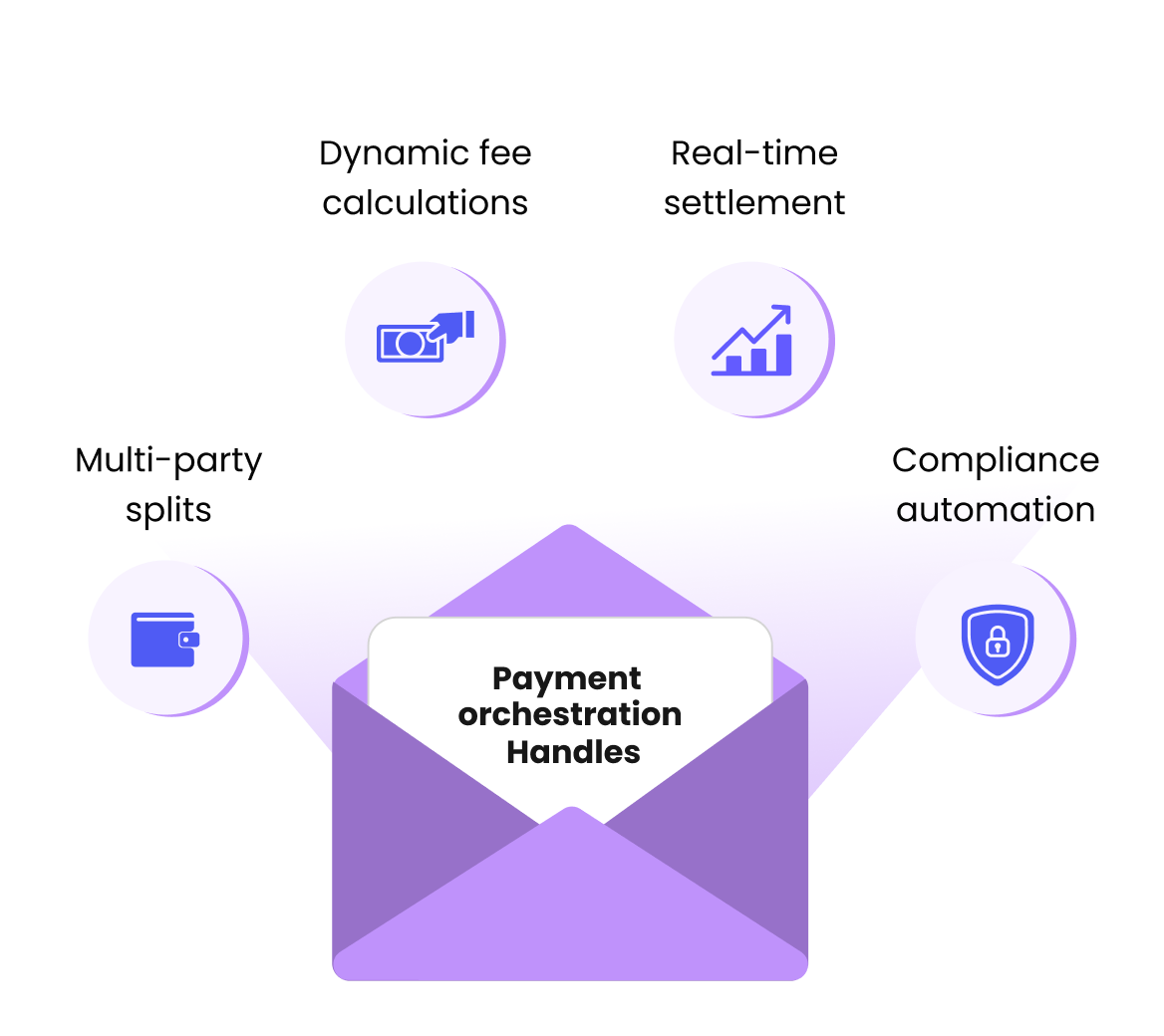
Real payment orchestration handles:
- Multi-party splits (seller, platform, service provider, driver, affiliate)
- Dynamic fee calculations (percentage, flat fee, tiered, promotional)
- Real-time settlement (instant payouts vs batched)
- Compliance automation (1099s, ABN reporting, employment classification)
- Reconciliation across parties (your books, theirs, and the tax office)
The Hidden Complexity That Breaks Most Platforms
1. The Settlement Timing Nightmare
Here's where 90% of platforms screw up: assuming all parties want to be paid the same way, at the same time.
Reality check:
- Restaurants want daily payouts (cash flow)
- Drivers want instant access (gas money)
- Affiliates are fine with monthly (simplicity)
- Platform needs to optimize fees and cash flow
Most platforms either force everyone into the same schedule (creating churn) or build complex custom logic for each use case (creating technical debt).
The MyGigsters approach: Configurable settlement policies per party type, with smart defaults based on industry patterns. One integration, multiple settlement strategies.
2. The Compliance Trap
When you're splitting payments, you're not just moving money—you're creating reportable transactions. Miss this and you'll get buried in:
- 1099 reporting requirements
- Employment classification audits
- State-by-state contractor compliance
- International tax obligations
- Know Your Business Customer (KYBC) requirements
Pro tip: Build compliance tracking into your payment flows from day one. Retrofitting compliance into an existing payment system is like performing surgery on a moving train.
3. Failed Transaction Recovery
Single-party payment fails? Retry or refund. Multi-party payment fails mid-transaction? Welcome to reconciliation hell.
Consider this scenario:
- Customer charged successfully ($100)
- Platform fee deducted ($15)
- Driver payment fails (bank account invalid)
- Restaurant payment succeeds ($75)
You now have:
- Angry customer (charged for incomplete service)
- Confused restaurant (paid but no driver)
- No driver (no payment, no motivation)
- Messy books (partial transaction)
Smart orchestration: Atomic transactions with configurable rollback policies. If critical parties can't be paid, the entire transaction should fail gracefully.
The Technical Architecture That Actually Scales
Core Components You Need
Customer Payment Gateway
       ↓
Payment Orchestration Engine
       ↓
├── Party Management
├── Fee Calculation Engine
├── Settlement Scheduler
├── Compliance Tracker
└── Reconciliation System
       ↓
Banking Rails (ACH, Real-time payments, Cards)
1. Party Management System
Every marketplace participant needs different treatment:
{
  "party_type": "driver",
  "payment_schedule": "instant",
  "fee_structure": "flat_rate_pickup",
  "compliance_class": "contractor_1099",
  "settlement_account"": "real_time_rails",
  "backup_method": "ach_next_business_day"
}
2. Dynamic Fee Calculation
Static commission rates are for platforms that don't want to grow. Modern marketplaces need:
- Dynamic rates (surge pricing, volume discounts, loyalty tiers)
- Multiple fee types (listing fees, success fees, payment processing)
- Promotional overrides (first-time user, referral credits)
- Cross-subsidization (platform absorbs fees for certain segments)
3. Smart Settlement Logic
IF party_type == "restaurant" AND day_of_week IN ["Mon", "Tue"]
   THEN settlement_speed = "next_business_day"
ELIF transaction_amount > $500 AND party_risk_score < 0.7
   THEN settlement_speed = "instant"
ELSE
   settlement_speed = "standard_batch"
Real-World Implementation Strategies
Phase 1: MVP Multi-Party Payments (Weeks 1-4)
Start simple but build for complexity:
- Basic two-party splits (platform + service provider)
- Fixed commission rates
- Daily settlement batches
- Manual reconciliation
Key principle: Get money flowing, then optimize.
Phase 2: Advanced Orchestration (Months 2-4)
- Multiple party types
- Dynamic fee structures
- Multiple settlement schedules
- Automated compliance tracking
Phase 3: Full Optimization (Months 4-6)
- Real-time payments
- ML-driven risk assessment
- Dynamic routing optimization
- Advanced reconciliation automation
The Economics of Getting This Right
Cost Analysis: Build vs. Buy vs. Hybrid
Full Custom Build:
- Development cost: $800K - $2M
- Timeline: 12-18 months
- Ongoing maintenance: $300K+/year
- Risk: High (compliance, security, scale)
Generic Payment Platform:
- Setup cost: $50K - $200K
- Timeline: 3-6 months
- Ongoing fees: 2.9% + 30¢ per transaction
- Limitation: Poor marketplace-specific features
Embedded Fintech Solution (MyGigsters model):
- Setup cost: less than $10K
- Timeline: 2-4 weeks
- Ongoing fees: Starts at 1.9% + competitive rates
- Benefits: Purpose-built for marketplaces
ROI Impact on Key Metrics
Platforms with proper payment orchestration see:
- 23% reduction in churn (faster, more reliable payments)
- 15% increase in transaction volume (better user experience)
- 60% reduction in finance team workload (automated reconciliation)
- 85% faster month-end close (real-time transaction tracking)
Common Orchestration Mistakes (And How to Avoid Them)
Mistake #1: Treating All Parties the Same
What happens: High churn among cash-dependent workers, frustrated enterprise clients
Fix: Configurable payment profiles per party type
Mistake #2: Ignoring Failed Payment Recovery
What happens: Broken transactions, manual cleanup, poor user experience
Fix: Atomic transaction logic with smart retry/rollback
Mistake #3: Compliance as an Afterthought
What happens: Regulatory trouble, manual reporting nightmare, classification risk
Fix: Compliance-first architecture from day one
Mistake #4: Over-Engineering Early
What happens: Delayed launch, feature creep, unnecessary complexity
Fix: Progressive sophistication—start simple, add features based on real usage
The Compliance Framework You Can't Ignore
Employment Classification Management
Modern platforms must track and prove contractor status:
- Work flexibility documentation
- Payment method preferences
- Multi-platform engagement
- Skill-based matching vs. assignment
Automated Tax Reporting
- Real-time 1099 threshold tracking
- Quarterly estimated tax alerts
- State-by-state compliance rules
- International contractor management
Financial Services Compliance
- Money transmission licensing (varies by state/country)
- Know Your Business Customer (KYBC) requirements
- Anti-money laundering (AML) monitoring
- Payment Card Industry (PCI) compliance
Future-Proofing Your Payment Architecture
Emerging Payment Rails
- FedNow (US): Real-time settlement, lower costs
- Open Banking: Direct account-to-account transfers
- Central Bank Digital Currencies: Instant, low-cost settlement
- Cross-border real-time: Expanding international options
Technology Trends to Watch
- AI-powered fraud detection: Pattern recognition across party types
- Smart contract automation: Programmable payment terms
- Carbon accounting: Environmental impact tracking for ESG
- Embedded insurance: Risk mitigation built into payment flows
Building vs. Buying: The Strategic Decision Framework
Build When:
- You have $2M+ development budget
- Payment innovation is core competitive advantage
- You need highly custom workflows
- You have experienced fintech engineering team
Buy When:
- You need to go live in <6 months
- Payment is infrastructure, not differentiation
- You want predictable costs and compliance
- You'd rather focus on core product features
Hybrid Approach (Recommended for Most):
- Use embedded fintech for core orchestration
- Build custom features on top of APIs
- Maintain control over user experience
- Leverage specialized expertise for compliance
Getting Started: Your 30-Day Implementation Plan
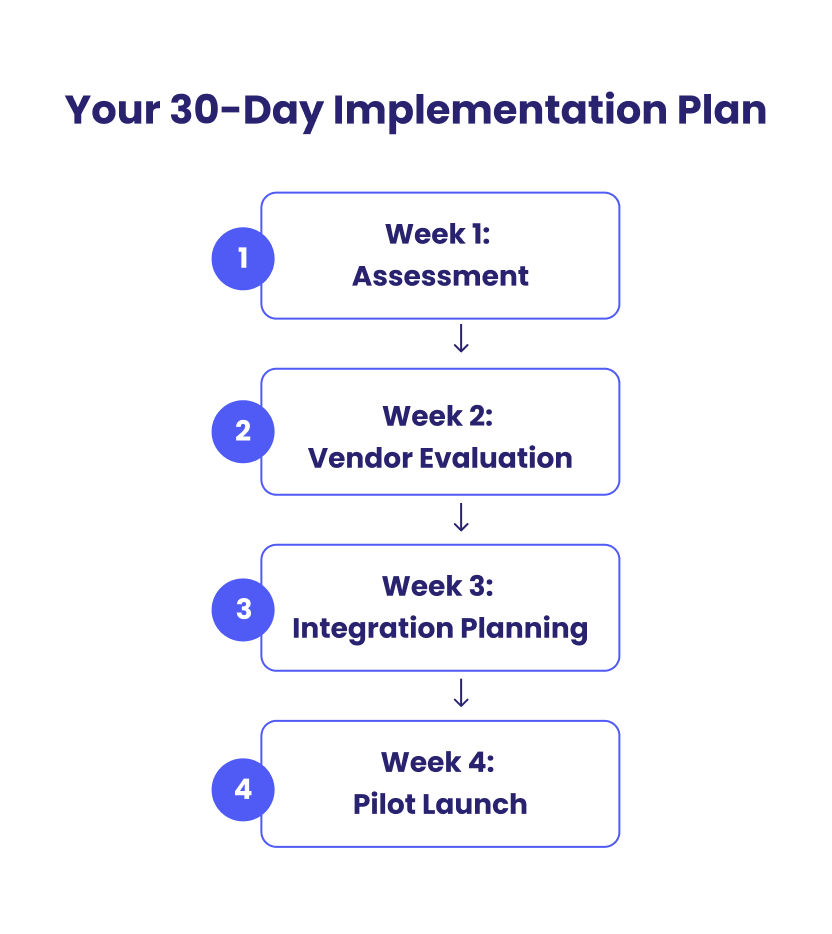
Week 1: Assessment
- Map current payment flows
- Identify all party types and settlement needs
- Document compliance requirements
- Calculate total cost of ownership
Week 2: Vendor Evaluation
- Test API documentation quality
- Validate marketplace-specific features
- Confirm compliance automation capabilities
- Review pricing models and scaling costs
Week 3: Integration Planning
- Design party onboarding flows
- Plan fee structure configuration
- Map reconciliation data requirements
- Define success metrics and KPIs
Week 4: Pilot Launch
- Start with single party type (lowest risk)
- Process small transaction volumes
- Test failure scenarios and edge cases
- Gather feedback from finance team
The MyGigsters Advantage: Purpose-Built for Marketplaces
While generic payment processors focus on single-party transactions, MyGigsters was built specifically for marketplace complexity:
- Pre-configured party types for common marketplace models
- Industry-specific compliance (healthcare credentials, logistics certifications)
- Automated reconciliation with popular accounting systems
- Real-time settlement options without enterprise pricing
- 2-4 week implementation vs. 6+ month custom builds
Key Takeaways: Building Payment Orchestration That Scales
- Start with compliance in mind - retrofitting is exponentially harder
- Design for multiple party types from day one, even if you start simple
- Atomic transactions are non-negotiable - partial failures destroy user trust
- Settlement flexibility drives retention - one size fits no one
- Real-time reconciliation saves more than time - it saves your sanity
Payment orchestration isn't just about moving money efficiently. It's about creating financial infrastructure that grows with your marketplace, keeps you compliant, and turns complex multi-party transactions into competitive advantage.
The platforms that get this right don't just process payments—they enable entirely new business models.
Frequently Asked Questions
How long does it typically take to implement payment orchestration for a new marketplace?
Custom builds take 12-18 months and $800K-$2M in development costs. Embedded solutions like MyGigsters can be implemented in 2-4 weeks with API-first integration, allowing you to focus on your core marketplace features rather than payment infrastructure.
What's the difference between payment orchestration and regular payment processing?
Regular payment processing handles simple customer-to-merchant transactions. Payment orchestration manages complex multi-party splits, dynamic fee calculations, different settlement schedules per party type, compliance tracking, and automated reconciliation across multiple participants.
How do you handle failed payments in a multi-party transaction?
Smart orchestration uses atomic transactions—if any critical party payment fails, the entire transaction rolls back gracefully. This prevents partial completion scenarios that create reconciliation nightmares and poor user experiences.
What compliance requirements apply to marketplace payment orchestration?
Key requirements include 1099 reporting for contractors, employment classification documentation, state-by-state contractor compliance, Know Your Business Customer (KYBC) verification, and potentially money transmission licensing depending on your business model.
Is it better to build payment orchestration in-house or use a third-party solution?
Build in-house only if you have $2M+ budget, 12+ month timeline, and experienced fintech engineering team. Most marketplaces benefit from embedded fintech solutions that provide marketplace-specific features, compliance automation, and faster time-to-market.
Ready to implement payment orchestration that actually works for marketplaces? Book a technical demo to see how MyGigsters handles complex multi-party payments, automated compliance, and real-time reconciliation in a solution built specifically for platform businesses."