Payment Orchestration for Marketplaces: The Complete Guide to Multi-Party Payment Management
Payment Orchestration for Marketplaces: The Complete Guide to Multi-Party Payment Management
If you've ever built a marketplace with multiple parties getting paid, you know the payment infrastructure quickly becomes a nightmare. What starts as ""we'll just use Stripe"" turns into months of custom development, compliance headaches, and reconciliation hell.
After running 19 different gig platforms and building payment infrastructure for dozens of marketplaces, here's what I've learned: payment orchestration isn't just nice-to-have infrastructure—it's the difference between a marketplace that scales and one that breaks at $1M GMV.
What is Payment Orchestration for Marketplaces?
Payment orchestration is the layer that sits between your marketplace and multiple payment providers, handling the complex routing, splitting, and settlement of multi-party transactions.
Think of it like air traffic control for payments. When a customer pays $100 on your platform:
- $75 goes to the service provider
- $20 is your platform fee
- $5 covers payment processing fees
Payment orchestration handles this automatically, including tax calculations, compliance checks, currency conversions, and real-time settlement—all while maintaining a single, clean API for your developers.
The Business Case: Why Every Marketplace Needs Payment Orchestration
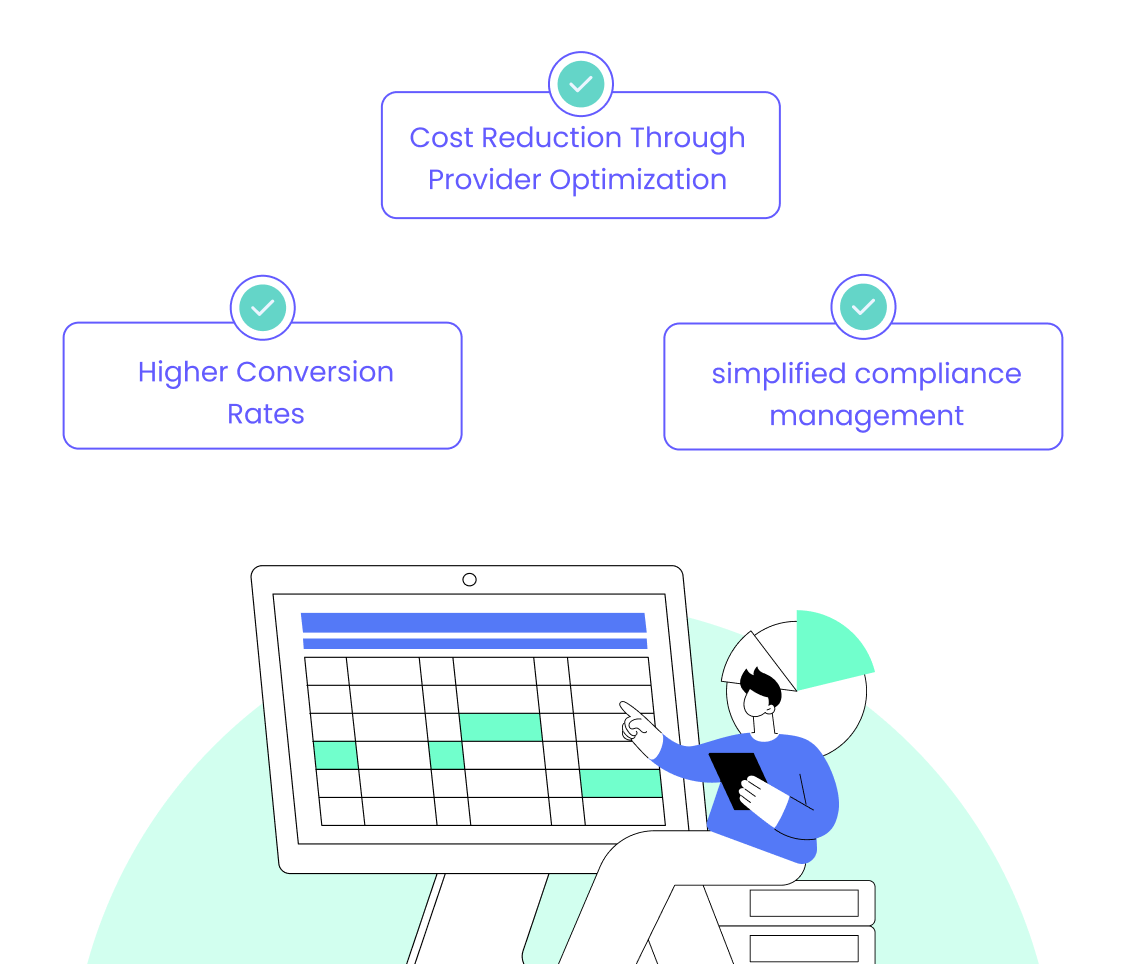
1. Cost Reduction Through Provider Optimization
Payment processors charge different rates for different transaction types. Visa charges less for recurring payments than one-time purchases. American Express has higher fees in Europe than in the US.
A well-configured payment orchestration system can reduce processing costs by 15-30% by automatically routing transactions to the lowest-cost provider for each specific use case.
For a marketplace doing $10M annual GMV, that's $150,000-$300,000 in annual savings.
2. Higher Conversion Rates
Payment failures kill conversions. When Stripe is down (it happens), your entire marketplace stops working.
With orchestration, failed payments automatically cascade to backup providers. A customer's Visa card fails on Stripe? The system instantly retries with Adyen. Still failing? Try Worldpay.
The result: 5-15% higher authorization rates, which translates directly to revenue.
3. Simplified Compliance Management
Every payment provider has different requirements for PCI compliance, KYC checks, and anti-money laundering. Managing compliance across multiple providers is a nightmare.
Payment orchestration provides a single compliance layer that handles all providers behind the scenes. Your team focuses on building marketplace features instead of payment compliance.
Technical Architecture: How Payment Orchestration Works
Here's how a modern payment orchestration system handles a marketplace transaction:
The Payment Flow
- Customer initiates a $100 payment
- Orchestration layer receives payment request with split requirements
- System analyzes transaction: Card type, customer location, transaction amount, and historical data
- Intelligent routing: Routes to optimal payment provider based on cost and success rates
- Multi-party split: $75 to service provider, $20 platform fee, $5 processing costs
- Real-time settlement: Funds are distributed according to your business rules
- Compliance & reporting: Tax calculations, regulatory reporting, and audit trails are automatically generated
Key Technical Components
- Payment Gateway Abstraction Layer: Normalizes APIs across providers
- Smart Routing Engine: ML-powered routing based on success rates and costs
- Split Payment Engine: Handles complex multi-party settlements
- Compliance Engine: Automated KYC, AML, and regulatory reporting
- Reconciliation System: Real-time transaction matching across providers
Build vs. Buy: Implementation Options for Marketplaces
Option 1: Build In-House
Building payment orchestration in-house gives you maximum control but comes with significant challenges:
Pros:
- Complete customization for your specific use case
- No vendor lock-in
- Long-term cost control
Cons:
- 18-24 month development timeline
- $2-5M initial investment
- Requires specialized payment expertise
- Ongoing compliance and security burden
Frequently Asked Questions
What is payment orchestration for marketplaces?
Payment orchestration for marketplaces is a system that manages multi-party payment flows, automatically routing transactions to optimal providers, handling payment splits between marketplace participants, and managing compliance across different payment processors.
How much can payment orchestration reduce costs?
Well-configured payment orchestration systems can reduce processing costs by 15-30% by routing transactions to the lowest-cost provider for each transaction type. For a marketplace doing $10M annual GMV, this translates to $150,000-$300,000 in annual savings.
What are the main components of a payment orchestration system?
Key components include: Payment Gateway Abstraction Layer (normalizes APIs), Smart Routing Engine (ML-powered routing), Split Payment Engine (multi-party settlements), Compliance Engine (automated KYC/AML), and Reconciliation System (real-time transaction matching).
How long does it take to implement payment orchestration?
Implementation time varies by approach: Building in-house takes 18-24 months and $2-5M investment. Using existing platforms like Stripe Connect takes 3-6 months. Embedded solutions like MyGigsters can be integrated in 2-4 weeks with pre-built marketplace optimization.
What compliance requirements does payment orchestration handle?
Payment orchestration handles PCI compliance, KYC (Know Your Customer) verification, AML (Anti-Money Laundering) checks, regulatory reporting, tax calculations, and audit trail generation across all integrated payment providers.
Can payment orchestration improve conversion rates?
Yes, payment orchestration typically increases authorization rates by 5-15% through intelligent routing, automatic failover to backup providers, and optimization for specific card types and geographies.
The Future of Marketplace Payments
Payment orchestration isn't just infrastructure—it's competitive advantage. As marketplaces mature and competition intensifies, the ability to optimize costs, maximize conversions, and scale globally becomes critical.
The marketplaces that win in the next decade will be those that understand payments as a strategic differentiator, not just a technical requirement.
At MyGigsters, we've built payment orchestration specifically for gig economy marketplaces, with pre-configured routing optimization, built-in compliance, and same-day settlement. If you're ready to optimize your marketplace payments, let's talk."